trunk TESLA MODEL S 2017 (UK) User Guide
[x] Cancel search | Manufacturer: TESLA, Model Year: 2017, Model line: MODEL S, Model: TESLA MODEL S 2017Pages: 186, PDF Size: 4.67 MB
Page 125 of 186

About the Security System
If Model S does not detect a key nearby and a
locked door or trunk is opened, an alarm sounds and headlights and turn signals
flash.To deactivate the alarm, press any button on the key.
To manually enable or disable the alarm
system, touch Controls > Settings > Safety &
Security > Alarm . When set to on, Model S
activates its alarm one minute after the doors
lock and a recognized key is no longer
detected nearby.
If Model S is equipped with the optional
security package, it includes a battery-backed
siren that sounds instead of the horn in situations where a locked door or trunk isopened and Model S does not detect a key
nearby. If the Tilt/Intrusion setting is on, the siren also sounds if Model S detects motioninside the cabin, a window is broken, or if it is
moved or tilted (for example, with a tow truck
or jack). To turn the tilt/ intrusion detection systems on or
off, touch Controls > Settings
> Safety & Security > Tilt/Intrusion .
Note: If you plan to leave something that
moves, such as a dog, inside your locked
Model S, remember to turn
off the tilt/
intrusion system. Any type of motion detected
inside Model S activates the siren.
Note: To turn on Tilt/Intrusion, the Alarm must
be ON.
Security Settings
Using the Touchscreen125
Page 154 of 186
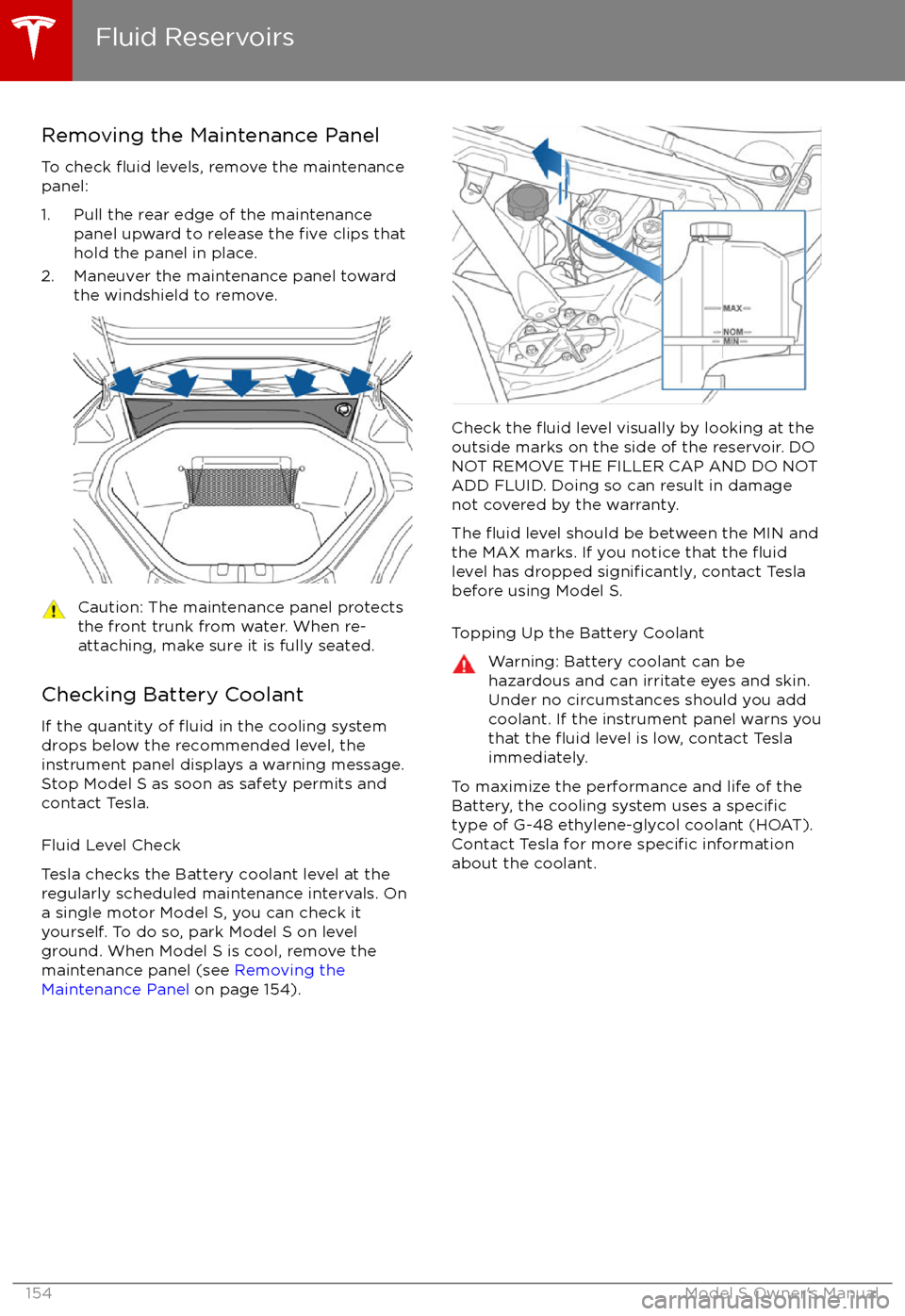
Removing the Maintenance Panel
To check
fluid levels, remove the maintenance
panel:
1. Pull the rear edge of the maintenance panel upward to release the
five clips that
hold the panel in place.
2. Maneuver the maintenance panel toward the windshield to remove.
Caution: The maintenance panel protects
the front trunk from water. When re-
attaching, make sure it is fully seated.
Checking Battery Coolant
If the quantity of
fluid in the cooling system
drops below the recommended level, the
instrument panel displays a warning message.
Stop Model S as soon as safety permits and
contact Tesla.
Fluid Level Check
Tesla checks the Battery coolant level at the
regularly scheduled maintenance intervals. On a single motor Model S, you can check it
yourself. To do so, park Model S on level
ground. When Model S is cool, remove the
maintenance panel (see Removing the
Maintenance Panel on page 154).
Check the fluid level visually by looking at the
outside marks on the side of the reservoir. DO
NOT REMOVE THE FILLER CAP AND DO NOT
ADD FLUID. Doing so can result in damage
not covered by the warranty.
The
fluid level should be between the MIN and
the MAX marks. If you notice that the fluidlevel has dropped significantly, contact Tesla
before using Model S.
Topping Up the Battery Coolant
Warning: Battery coolant can be
hazardous and can irritate eyes and skin.
Under no circumstances should you add
coolant. If the instrument panel warns you
that the
fluid level is low, contact Tesla
immediately.
To maximize the performance and life of the
Battery, the cooling system uses a specifictype of G-48 ethylene-glycol coolant (HOAT).
Contact Tesla for more specific information
about the coolant.
Fluid Reservoirs
154Model S Owner
Page 156 of 186
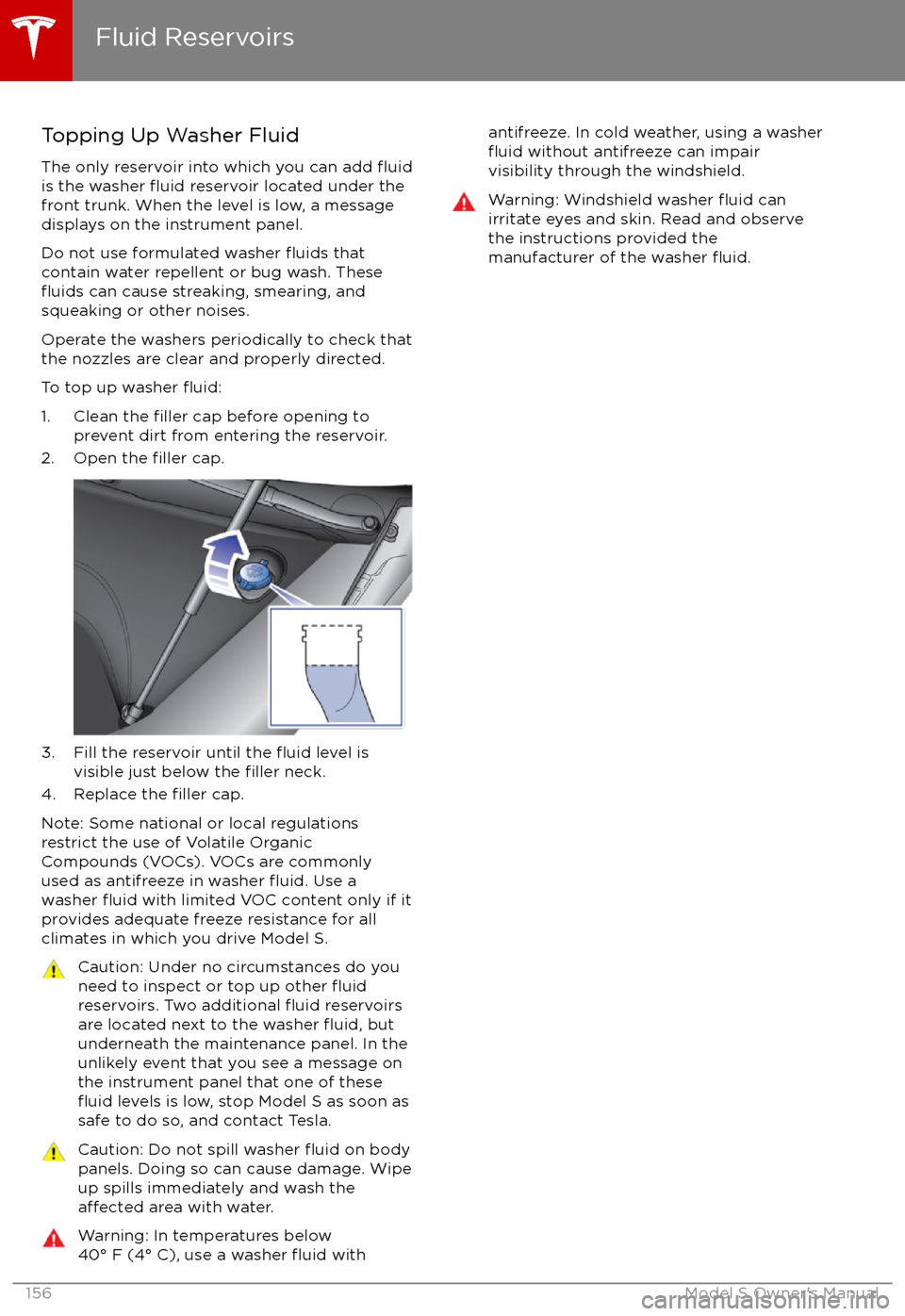
Topping Up Washer Fluid
The only reservoir into which you can add
fluidis the washer fluid reservoir located under the
front trunk. When the level is low, a message
displays on the instrument panel.
Do not use formulated washer
fluids that
contain water repellent or bug wash. These
fluids can cause streaking, smearing, and
squeaking or other noises.
Operate the washers periodically to check that
the nozzles are clear and properly directed.
To top up washer
fluid:
1. Clean the filler cap before opening to
prevent dirt from entering the reservoir.
2. Open the
filler cap.
3. Fill the reservoir until the fluid level is
visible just below the filler neck.
4. Replace the filler cap.
Note: Some national or local regulations
restrict the use of Volatile Organic
Compounds (VOCs). VOCs are commonly
used as antifreeze in washer
fluid. Use a
washer fluid with limited VOC content only if it
provides adequate freeze resistance for all climates in which you drive Model S.
Caution: Under no circumstances do you
need to inspect or top up other fluidreservoirs. Two additional fluid reservoirs
are located next to the washer fluid, but
underneath the maintenance panel. In the
unlikely event that you see a message on the instrument panel that one of these
fluid levels is low, stop Model S as soon as
safe to do so, and contact Tesla.
Caution: Do not spill washer fluid on body
panels. Doing so can cause damage. Wipe
up spills immediately and wash the
affected area with water.
Warning: In temperatures below
40
Page 160 of 186

Load Capacity LabelingIt is important to understand how much
weight your Model S can safely carry. This weight is called the vehicle capacity weight
and includes the weight of all occupants,
cargo and any additional equipment added to your Model S since it was manufactured.
There are two labels attached to Model S that
state how much weight it can safely carry.
These labels are located on the center door
pillar and are visible when the front door is
open:
1. Tire and Loading Information label
2. Statutory Plate
Warning: Overloading Model S has an
adverse effect on braking and handling,
which can compromise your safety or damage Model S.Caution: Never load more than 300 lbs(136 kg) in the front trunk. Doing so can
cause damage.Caution: Never store large amounts of
liquid in Model S. A significant spill can
cause electrical components to
malfunction.Tire and Loading Information Label
The Tire and Loading Information label
provides:
Page 174 of 186
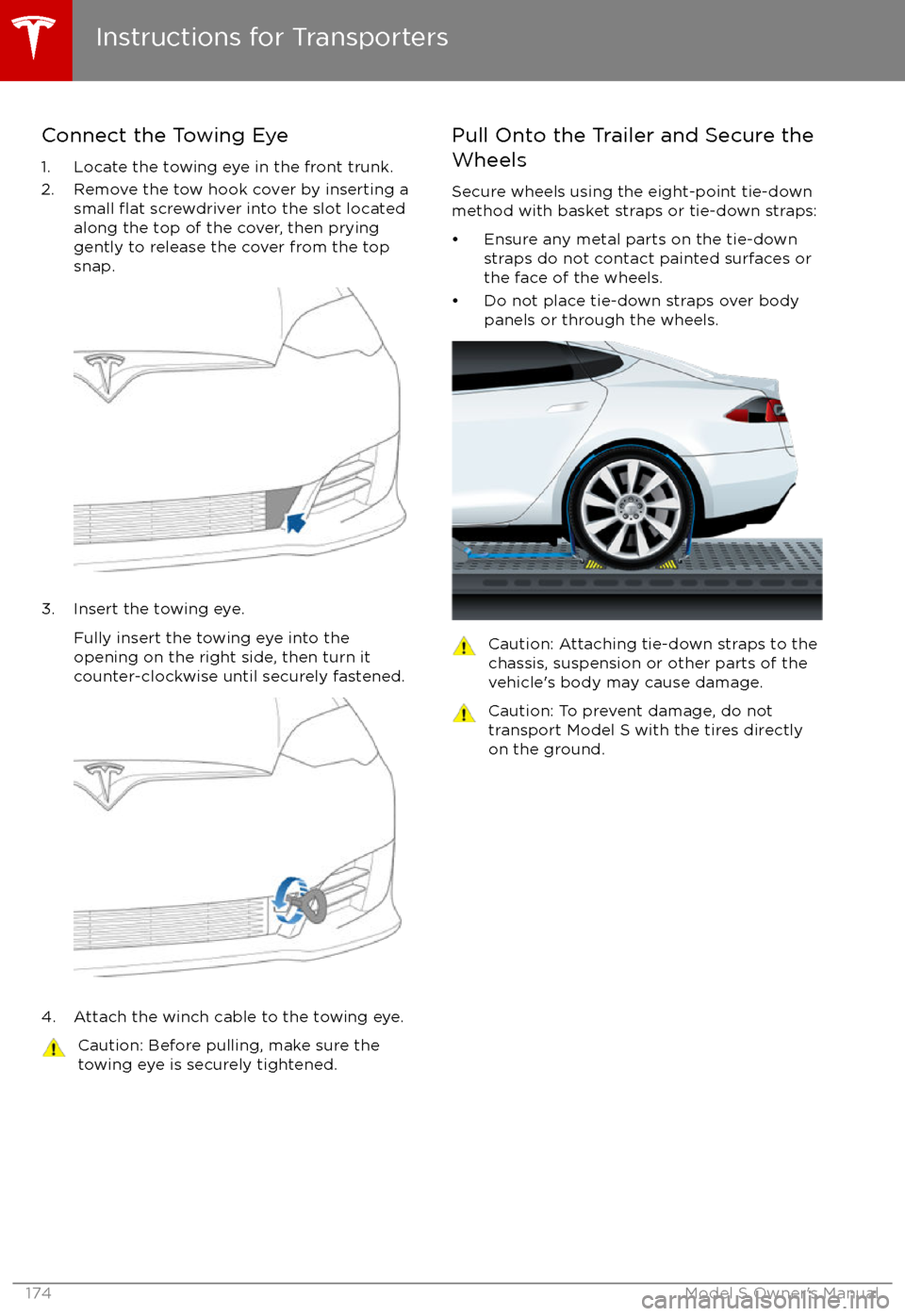
Connect the Towing Eye1. Locate the towing eye in the front trunk.
2. Remove the tow hook cover by inserting a small
flat screwdriver into the slot located
along the top of the cover, then prying
gently to release the cover from the top
snap.
3. Insert the towing eye.
Fully insert the towing eye into the
opening on the right side, then turn it
counter-clockwise until securely fastened.
4. Attach the winch cable to the towing eye.
Caution: Before pulling, make sure the
towing eye is securely tightened.Pull Onto the Trailer and Secure the
Wheels
Secure wheels using the eight-point tie-downmethod with basket straps or tie-down straps:
Page 182 of 186

D
DAB radio 113
dashboard overview 2
data recording 177
day mode 101
declarations of conformity 179
delivery mileage 177devicesBluetooth, playing audio files 115
connecting 115
playing audio
files from 115
dimensions 162
display brightness 101
dome (map) lights 51
door handles 6
door labels 160
Door Unlock Mode 6
doors 4
doors, opening 4
Drive gear 44
drive-away locking 7
driverprofiles 37
seat adjustment 17driver assistanceAuto Lane Change 79
automatic emergency braking 88
Autopark 81
Autosteer 76
blind spot warning 86
collision avoidance assist 88
forward collision warning 88
overtake acceleration 70
overview 68
settings for 101
side collision avoidance 86
side collision warning 86
speed assist 91
speed limit warning 91
staying inside lane markings 86
staying within speed limits 91
Traffic-Aware Cruise Control 70
drivingseating position 17
starting 43
tips to maximize range 65
E
electric parking brake 58
emergency
flashers 55
emergency rear door opening 8
energygained from regenerative braking 58
range information 45
energy & charging setting 101
Energy app 65
energy saving mode
65
Erase & Reset 104
event data recording 177exteriorcar cover 151
cleaning 149
dimensions 162
lights 51
overview 3
polishing, touch up, & repair 151
F
factory defaults, restoring 104
factory reset 104
fan speed, interior 106
favorite destinations 122
Favorites 119
Favorites (Media Player) 114
FCC
certifications 179
features, downloading new 129
ferries, avoiding 120
firmware (software) updates 129flash drives, playing audio files from 115flashers, warning 55flat tire repair 145floor mats 151
fluidsreplacement intervals 138
reservoirs, checking 154
fog lights 51
forward collision warning 88
front passenger detection 35
front trunk 12
G
garage doors, opening 126
gates, opening 126
GAWR 160
gears 44
glove box 14
Gross Axle Weight Rating 160
Gross Vehicle Weight Rating 160
ground clearance 162
GVWR 160
H hazard warning
flashers 55
head supports 18
headlightsadaptive 54
after exit 54
high beams 54
heated wipers 56
Index
182Model S Owner
Page 185 of 186

steering wheeladjusting position 39
adjusting sensitivity 39
buttons 39
heated 39
scroll bars 39
steering, automatic 76
summer tires 142
Summon 81
sunroof 15
suspension 111
suspension
specifications 165
T
telematics 177
temperatureBattery (high voltage), limits 133
cabin, controls for 105
heated steering wheel 41
outside 45
tie-down straps 174
tilt detection 125
Tire and Loading Information label 160
tire noise 142
Tire Pressure Monitoring SystemFCC certification 180
overview of 143
tire pressures, checking 139
tire repair kitinflating with air only 147inflating with sealant 146
replacing the sealant canister 148tiresall-season 142
balancing 140
chains 142
inspecting and maintaining 140
pressures, how to check 139
replacing 141
replacing a tire sensor 143
rotation 140
specification 167
summer 142
tire markings 168
tire sealant 145
winter 142
toll system transponders, attaching 158
tolls, avoiding 120
torque
specifications 164
touch up body 151
touchscreenclean mode 150
cleaning 150
Controls 98
overview 93
Settings 101
software updates 129Tow mode 173
towing 173
towing a trailer 161
towing eye, locating 174
towing instructions 173TPMSFCC certification 180
overview of 143
traction control 59
trademarks 175, 176
Traffic-Aware Cruise Control 70Traffic-Based Routing 120
trailer hitches 161
transmission
specifications 164
transponders, attaching 158
transporting 173
trip chart 65
trip meter 64
trip overview 120
trip planner 120
trunk, front 12
trunk, rearchild protection lock 7
disabling interior handle 7
TuneIn radio 114
turn signals 54
Typical range 101
U ultrasonic sensors 68
Unlock on Park 4
unlockingtrunk, front 12
trunk, rear 10
unlocking and locking doors 4
unlocking when key doesn